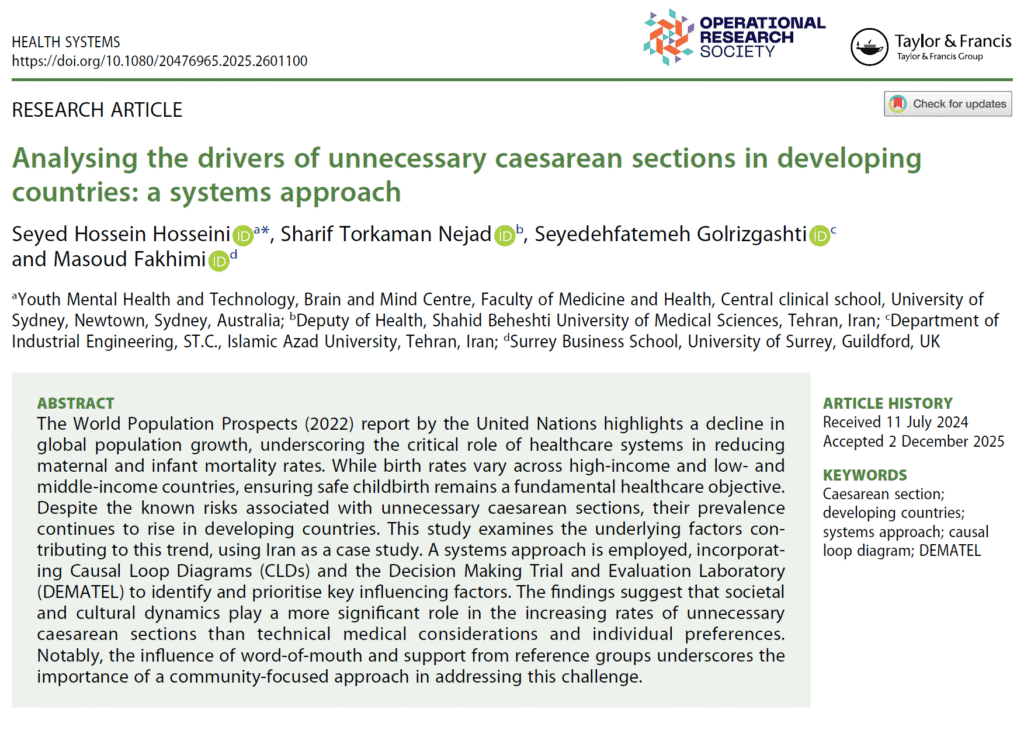
My latest paper, Analysing the drivers of unnecessary caesarean sections in developing countries: a systems approach, has just been published in Health Systems.
Access the paper
👉 Read the full paper here:
https://doi.org/10.1080/20476965.2025.2601100
A few highlights from the paper
At first glance, this paper is about caesarean sections. But at a deeper level, it is about how health system outcomes emerge from complex social dynamics, not just clinical decisions.
We applied a systems approach—combining causal loop diagrams with DEMATEL—to unpack why unnecessary caesarean sections continue to rise in developing countries, despite well-established medical evidence and guidelines. What the analysis revealed was not surprising:
The dominant drivers were not technical medical factors, nor purely individual preferences, but societal, cultural, and relational dynamics.
Word-of-mouth, reference groups, shared beliefs, and social reinforcement loops turned out to be far more influential than isolated clinical considerations. In other words, this is not a problem that can be “fixed” by protocols alone. It is a systemic issue, shaped by feedback, norms, incentives, and trust.
This work reflects something I have become increasingly convinced of over the years:
Many of our most persistent complex challenges are not failures of knowledge, but failures of system design. So, we need to shift conversations from “who is responsible” to “how the system produces what we observe”—and how it might be redesigned to support a more sustainable future.
I am grateful to my co-authors, Sharif Torkaman Nejad, Seyedehfatemeh Golrizgashti & Masoud Fakhimi, for their collaboration, and to the reviewers and editors who engaged deeply with the systems perspective. If you’re interested in discussing its implications for your organisation or context, I’d love to connect and chat.
Full Abstract
The World Population Prospects (2022) report by the United Nations highlights a decline in global population growth, underscoring the critical role of healthcare systems in reducing maternal and infant mortality rates. While birth rates vary across high-income and low- and middle-income countries, ensuring safe childbirth remains a fundamental healthcare objective. Despite the known risks associated with unnecessary caesarean sections, their prevalence continues to rise in developing countries. This study examines the underlying factors contributing to this trend, using Iran as a case study. A systems approach is employed, incorporating Causal Loop Diagrams (CLDs) and the Decision Making Trial and Evaluation Laboratory (DEMATEL) to identify and prioritise key influencing factors. The findings suggest that societal and cultural dynamics play a more significant role in the increasing rates of unnecessary caesarean sections than technical medical considerations and individual preferences. Notably, the influence of word-of-mouth and support from reference groups underscores the importance of a community-focused approach in addressing this challenge.
Keywords
Caesarean section, developing countries, systems approach, causal loop diagram, DEMATEL .

Let’s learn Systems Modelling together!
I share useful information about Systems Modelling here weekly.