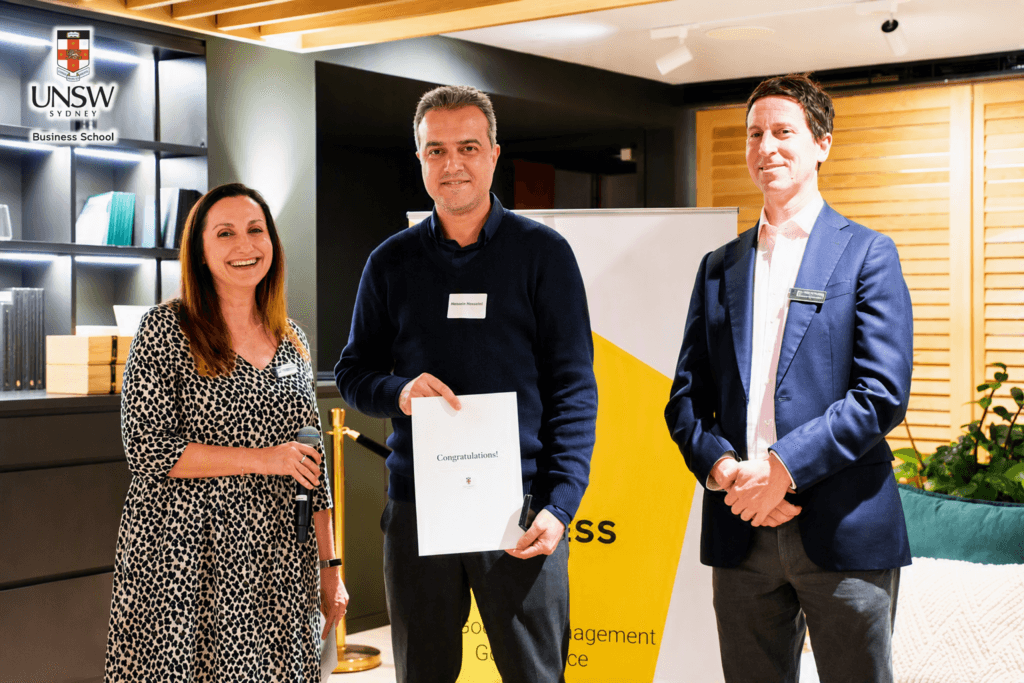
I am grateful to have received an Exceptional Contribution award for my teaching at UNSW Business School. The award recognises those who have made a particularly meaningful contribution to students learning with collegiality and a commitment to supporting the school teaching community.
While receiving an award is personally meaningful, it also provides an opportunity to reflect on what I have been trying to achieve through my teaching.
Teaching Students to Engage with Complexity
My teaching is centred on systems thinking and system dynamics modelling. These approaches help students understand complex problems by examining feedback, delays, interdependencies, and unintended consequences.
For me, teaching systems thinking and system dynamics modelling is not simply about introducing students to causal loop diagrams, stock-and-flow models, or simulation techniques. These are important tools, but the deeper objective is to help students develop a more reflective way of thinking about dynamic complex problems. This supports better reasoning and decision-making in organisations, policy settings, and many other environments where problems cannot be understood through simple, linear explanations.
Experimenting with AI as a Learning Facilitator
With invaluable support from Professor Shayne Gary during the term, I continued exploring how AI could be embedded thoughtfully into systems thinking and system dynamics education.
The purpose was not simply to introduce students to a new technology. Nor was it to use AI as a shortcut for producing models or completing assessments. Instead, I wanted students to explore how AI could function as a learning facilitator and thinking partner.
Students were encouraged to use AI to challenge and refine their causal loop diagrams and stock-and-flow models, consider alternative model structures, test assumptions, and reflect on the quality of their reasoning. This created an additional layer of learning. Students were not only developing models of complex systems, but also examining how a technological tool could influence their thinking and interpretation of those systems.
This is increasingly important in an AI-augmented learning environment. The quality of the outcome depends not only on what a tool can produce, but also on the quality of the questions asked, the assumptions provided, and the judgement used to assess its responses. Critical thinking therefore remains central. In fact, it becomes even more important.
I previously reflected on this teaching approach in the following blog on “Embedding AI into System Dynamics Education: Reflections from This Term”.
Looking Ahead
This award is an encouraging recognition, but it is also a reminder that teaching is an ongoing process of learning and improvement.
There is still much to explore about how systems thinking should be taught, how system dynamics modelling can be made more accessible without losing its analytical depth, and how AI can support learning while preserving human judgement, intellectual responsibility, and critical reflection.
I look forward to continuing this work and further developing learning experiences that help students approach complexity with greater confidence, curiosity, and care.
I’m grateful to my colleagues for their collaboration and support, particularly Professor Shayne Gary, and to the students whose curiosity and engagement make teaching so rewarding.