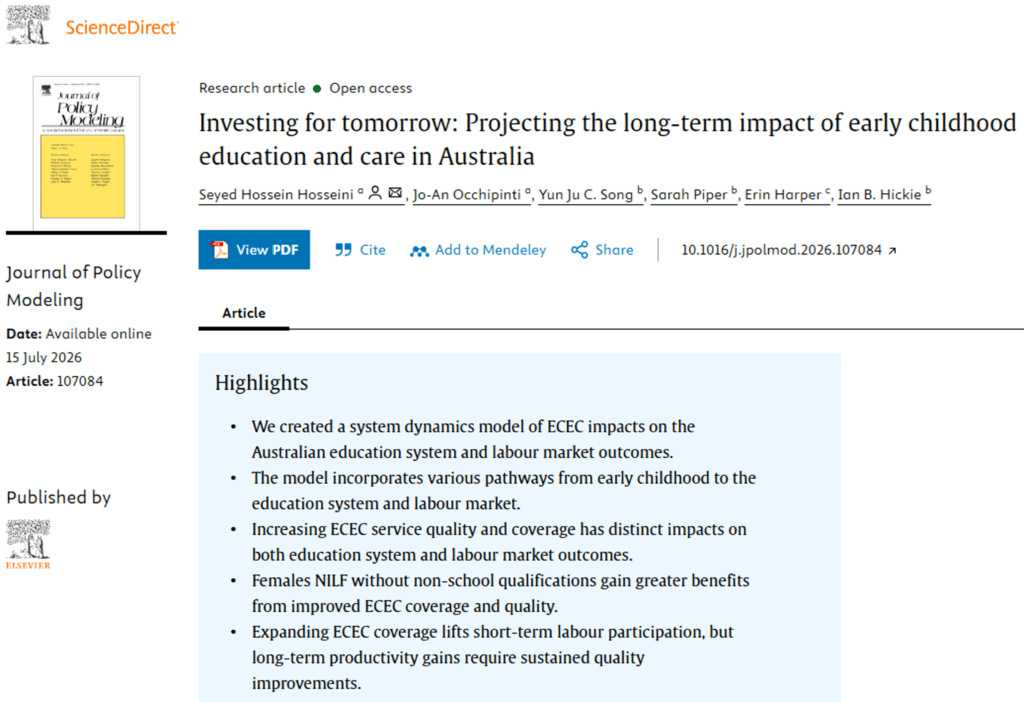
Our newly published paper in the Journal of Policy Modeling, entitled “Investing for tomorrow: Projecting the long-term impact of early childhood education and care in Australia”, examines the interconnected relationships between early childhood education and care (ECEC), the Australian education system, and labour market outcomes through a system dynamics modelling approach.
Few would disagree that early childhood matters. Decades of research have demonstrated that experiences in the first five years of life influence children’s cognitive, social, emotional, and educational development.
What remains less understood is how changes in early childhood education and care (ECEC) ripple through the wider system over time.
How does improving ECEC quality affect patterns of school participation years later? What happens when more children have access to ECEC services? How might these changes influence labour force participation, educational attainment, and economic productivity over the long term?
Looking Beyond the ECEC Sector
Policy debates often focus on immediate ECEC challenges such as affordability, accessibility, workforce shortages, or quality standards. These are critical issues, but they represent only part of the picture.
ECEC sits within a much larger system. Children’s experiences in the early years influence their readiness for school, educational progression, qualification attainment, workforce participation, and employment outcomes later in life. At the same time, ECEC affects parental workforce participation and broader economic performance.
To capture these interactions, we developed a simulation model representing the movement of population cohorts from birth, through ECEC, schooling, tertiary and vocational education, and ultimately into different labour market states including employment, unemployment, and not-in-labour-force (NILF). The model provides a decision-support tool for exploring how policy interventions implemented today may influence outcomes many years into the future.
Quality and Coverage Matter, but They Work Differently
One of the key findings from the study is that ECEC quality and ECEC coverage influence the system through different pathways.
Increasing ECEC quality primarily strengthens educational outcomes. The simulations indicate improvements in school participation, reductions in developmental vulnerability, and fewer young people leaving school into unemployment or labour force disengagement.
Increasing ECEC coverage, on the other hand, has stronger impacts on labour market outcomes. Greater participation in ECEC reduces the number of people who are not participating in the labour market and increases the number of employed people over time.
This distinction is important because policy debates often treat access and quality as interchangeable goals. Our results suggest they are complementary but not equivalent policy levers. The biggest gains come from combining both. The simulations suggest that combining increased ECEC coverage with improved ECEC quality generates substantially stronger outcomes than focusing on either strategy alone. Under the combined scenario, developmental vulnerability declines more rapidly, school participation improves, labour market participation increases, and the number of people not participating in the labour force falls considerably relative to business-as-usual projections.
Who Benefits Most?
The model also highlighted important differences across groups. One particularly notable finding was that women aged 15–44 who are not in the labour force and who do not hold non-school qualifications benefit disproportionately from improvements in ECEC quality and coverage. The combined policy scenario resulted in larger reductions in this group compared with the broader female NILF population.
This finding suggests that ECEC policy should not be viewed solely as an education policy. It is also relevant to labour market participation, gender equity, and workforce development.
What Does This Mean for Australia?
Expanding access to ECEC can help lift labour force participation in the shorter term. Sustained improvements in educational attainment and long-term productivity, however, require continued investment in quality. Policymakers should therefore resist framing quality and coverage as competing priorities. The greatest benefits emerge when both are pursued together through a coordinated, long-term strategy.
As Australia continues to invest heavily in the ECEC sector, understanding these interconnected dynamics will become increasingly important. System dynamics modelling offers a way to move beyond short-term indicators and explore how today’s policy decisions may shape educational, social, and economic outcomes for decades to come.
Access the paper
This is published in the Journal of Policy Modeling and is accessibleHERE.
Article highlights
- We created a system dynamics model of ECEC impacts on the Australian education system and labour market outcomes.
- The model incorporates various pathways from early childhood to the education system and labour market.
- Increasing ECEC service quality and coverage has distinct impacts on both education system and labour market outcomes.
- Females NILF without non-school qualifications gain greater benefits from improved ECEC coverage and quality.
- Expanding ECEC coverage lifts short-term labour participation, but long-term productivity gains require sustained quality improvements.
Full Abstract
The medium- to long-term impact of Early Childhood Education and Care (ECEC) on the Australian education system and labour market is investigated. The simulation results suggest that increased ECEC quality yields greater participation in education and a reduction in rates of school-leavers being unemployed/Not-In-Labour-Force; further, an increase in coverage of ECEC is projected to noticeably reduce the number of people Not-In-Labour-Force and unemployed and increase the number of employed. Findings highlight the need for ECEC policy to adopt a balanced approach to promoting both ECEC access and quality, to maximise education and labour market outcomes.
Keywords
Early childhood education and care, Education system, Labour market, System dynamics, Australia

Let’s learn Systems Modelling together!
I share useful information about Systems Modelling here weekly.